My favorite conveniences for the first days postpartum…

My favorite conveniences for the first days postpartum…

If you’re like me, sometimes you roll your eyes at yet one more advertised item deemed a “necessity” for baby. Seriously, what more does a newborn need than diapers, a few blankets, and mama to snuggle with, sleep close to, and nurse whenever he wants? I’m not saying some of these accessories aren’t helpful-I have my favorites gizmos that I find to be a blessing (the bouncer and Bumbo being at the top of the list!), but I think we can forget that babies don’t need 101 items in order to survive the first days and weeks. That said, after having my third child earlier this year, I was reminded once again that there are some things out there, that while not necessities, can help in easing the transitions and recovery process during the initial postpartum period. I keep thinking I need to write them down, in order to share them with other mamas-to-be, so here’s my attempt at listing some of my very favorite postpartum items to have on hand:

Note: this list is totally of my own making, and the links given are solely for your benefit-these are NOT affiliate links, nor do I receive any compensation for posting these!

For Mom:

  • Depends/Disposable Underwear:
    • No joke! This may be the only time in your life when disposable underwear seem wonderful. They are comfortable, keep you and the sheets clean, and make life easier…

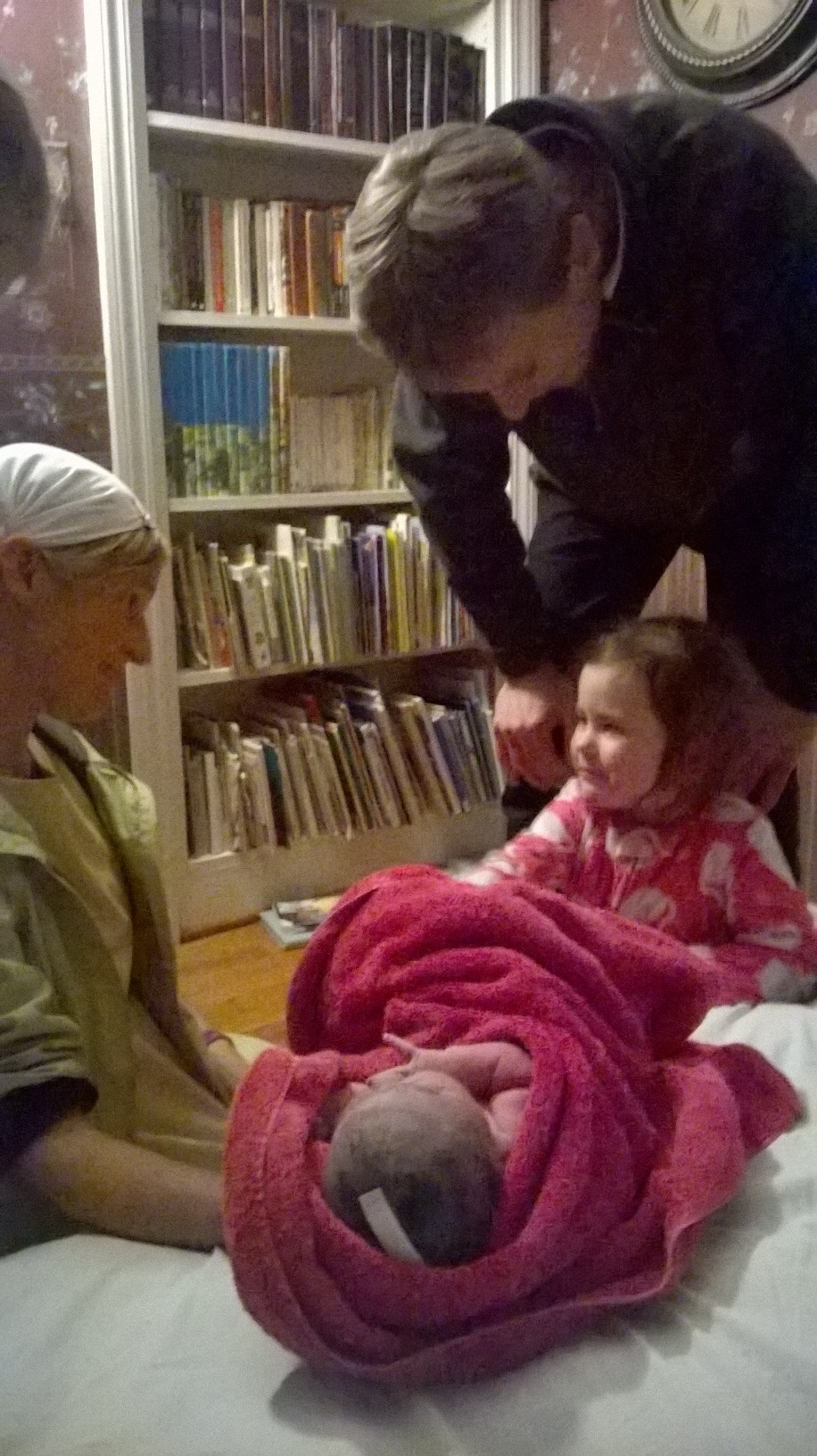
      Snuggling with my littlest and the new big sister

      Snuggling with my littlest and the new big sister

  • A good quality, comfortable nursing bra:
    • It’s been my experience that higher cost = higher comfort when it comes to nursing bras. My absolute favorite is the Bravado! Seamless Body Silk. It’s adjustable, has no wires, is easy to use, and adjusts to your continuing adjusting size during those first weeks!
  • Nursing Cups:
    • These were new to me, recommended by a client. But I’ve found them to be a life saver during the days your milk comes in and your body is trying to adapt! They relieve some of the pressure, giving you some relief, and make it easier for a newborn to latch on. Depending upon my milk supply and the infant, I’ve used them for anywhere between 48 hours to 3 weeks as we get the latch/supply/demand/initial soreness figured out. If you struggle with inverted or flat nipples, these can also help to pull the nipple out, making nursing go much better. Here’s the ones I use: http://www.amazon.com/Pharmics-0813-0099-00-O-cal-ette-Nursing-Cup/dp/B002UKXLJK
  • Wish Garden New Mother’s Salve:
    • Nothing beats this salve in being the ultimate for nipple care and repair. Used after every feeding, it helps relieve soreness, heal trauma, and is a general all-purpose healing salve for about anything else, to boot. We keep it around and use it for wounds, bruises, etc. when it’s not being used for a newly nursing mommy! Find it here: http://www.inhishands.com/new-mothers-healing-salve/
  • Maxi-Milk herbal tincture:
    • Whenever I sense my milk supply is low, a few days of using this supplement always makes a difference. I keep it on hand for those times when baby is experiencing a growth spurt, sleep is in short supply, or when the schedule is unusually hectic. A hungry baby is an unhappy one, which then makes for a stressed mama! Nothing else I have tried works like this stuff does. Order it from: mountainmeadowherbs.com
  • Nursing pillow or several extra pillows:
    • Having a good pillow handy during those first days of breastfeeding can help get baby in a good position, and keep your back from the strain of bending over…sometimes you don’t even realize you are bending over or getting uptight as you help baby nurse…but this can help you relax and save you from some stressed muscles!
  • A few good books:
    • The first 2 weeks after baby comes are a critical time for you as a mom to lay low, rest, and enjoy these first days with your baby. I’m always amazed at how long it takes a newborn to nurse those first weeks, and I find that I enjoy having a few good books around from my “reading wish list” to enjoy makes that time feel like a mini-vacation.
  • Thank you notes:
    • I know, you need to rest those first days, but I find, too, that those first 2 weeks while I have extra help around and meals coming in are the best times to write little notes. Once I start getting back into “real life”, that time evaporates. So I like to be prepared ahead of time, with blank note cards so I can keep from getting behind on writing notes to those who bless us!

      Enjoying my little "vacation"...you can see my little tote on the end table

      Enjoying my little “vacation”…you can see my little tote on the end table

  • Postpartum Tote:
    • Before my baby came, I prepared a little portable tote basket with the essentials I would need, in order to eliminate trips up and down the stairs. It contained nursing pads, salve, diapers, wipes, and a few other items that I might need, and I kept it on the end table by the couch. It saved me many steps, as the rest of the baby items were upstairs!


 

For Baby:

  • Coconut Oil:
    • This stuff is amazing for baby skin care! With the antibactieral properties, it helps to keep cradle cap and baby acne at bay, as well as nourishing baby’s tender skin, and adding moisture during dry months. This time I purchased the liquefied oil, in order to make it easier to use, and sometimes I’d add a drop or two of some sweet-smelling essential oil to lather baby with after her bath.

      All cozy in her muslin blanket while big brother holds her hand!

  • Bulb Syringe:
    • The 2oz. size works the best, in my opinion. Many times your midwife will include one in your birth kit, but they can also be purchased from medical or birth supply companies. These are great for the occasional gagging babies due on mucus, or for cleaning out stuffy little noses so baby can sleep better.
  • Muslin Swaddle Blankets:
    • I love these! While the name brands do seem to be the softest, the “off brands” work as well! The cotton is breathable, allowing baby to be comfortable while still feeling secure when wrapped tightly. And they make great nursing covers, or sun shades for baby…and they are big enough they can still be used when baby is past the newborn stage!
  • Baby Book:
    • If I don’t have a baby book ready to write in, then I miss so many little events of those first few days. Plus, the extra time mama has to sit and hold baby also translate into a few extra minutes to jot things down as they happen, rather than trying to remember after the fact!


      Lots of love and kisses!

      Lots of love and kisses!

So, what are your favorite items? Anything you would add, or give to a new mama? I’d love to hear your suggestions and thoughts!

Announcing our new arrival…

Baby Talitha joined our family on Feb. 18th, born at home, and weighing in at almost 9#! We are thoroughly enjoying her, and this explains why I may not have responded to your emails or other communication if you’ve tried to get in touch with me recently. More details regarding her birth will be shared eventually, once I have a chance to process everything, recover, and become a bit more accustomed to life with three little ones. 🙂

For now, here’s some pictures of our sweetheart:

WP_20150219_012

Sisters meeting for the first time…midwife getting ready to perform the newborn exam

WP_20150219_054

Happy siblings!

WP_20150219_064

2 days old…

WP_20150224_001

Sleeping peacefully all wrapped up

We love her!

We love her!

Suggestions for a Healthy Pregnancy

Suggestions for a Healthy Pregnancy

Recently I’ve been searching for a short, easy-to-read handout on nutrition and exercise. I was having trouble finding what I wanted…something that hit the high points, but wasn’t so detailed that no one would take the time to read it. Here’s what I came up with, though there is SO much more that could be said. I encourage each of you mama’s to research nutrition, supplements and exercise so that you know WHY you are doing what you’re doing for you and your baby!

2266-19942-1-SPDuring pregnancy, your body faces extra demands and nutritional needs. Making wise choices in caring for your physical needs can help to build a healthy baby, improve your energy levels, experience less complications during birth, and have a more rapid recovery. How is that for motivation?

Diet Recommendations:
There are many varied suggestions out there as far as pregnancy diet goes. While it is important for you to do your research and make the best choices for your particular situation, the following are a few principles to go by when it comes to what you eat:
– Major on high-quality protein. Protein helps to give you sustained energy, builds good skin integrity, and keeps your blood sugars in check. Some ideas include: Greek yogurt, cheese, nuts, nut butter, chia seeds, eggs, meat, and seeds.
– Consume a variety of vegetables, preferably organic whenever possible. This helps to provide you with more fiber, and the multitude of natural vitamins and minerals that vegetables contain.
– Add quality oils to your diet. Recent research has proven that quality fats are good for us, contrary to what we used to be told! Coconut oil, olive oil, and butter (esp. if it’s grass fed!) are examples of good fats to be consuming.
– Reduce your intake of carbs-especially simple carbs. While carbohydrates are good in moderation, they shouldn’t be considered the foundation of your diet. Carbohydrates tend to elevate blood sugar levels, as well as adding extra pounds to you and the baby during the last several months of pregnancy. When eating carbs, do your best to make sure they are made of whole grains whenever possible, which provide you with fiber and a slower sugar release. Using a variety of organic grains (such as oats, spelt, rye, etc.) are better choices than only consuming wheat products.
– Stay away from artificial sugars, and limit your intake of refined sugar. Try using maple syurp, honey, coconut sugar or other more natural-type sugars when you need something sweet!
– Try to limit fruit juices, and eat whole fruit instead.
– Keep healthy snacks on hand, so that it’s easiest to make good choices when you’re hungry!
Supplements:
Ideally, your nutritional needs should be met through a healthy, balanced diet. But most of us can still use a bit more help!  The basis of your supplements should include a high-quality prenatal vitamin, one made from natural food sources instead of being chemically engineered. Seeking Health, New Chapter Organic, and Thorne Research are good brands, but there are more out there. Most moms are also lacking in sufficient calcium and magnesium, and I recommended taking a minimum of 1000 mg. of calcium each day. This can also help you to sleep better at night, and experience less muscle cramping and discomfort. Other supplements are normally suggested and added as needed, and we can discuss your particular needs during our prenatal visits.newborn

Exercise:
In preparing for your labor and birth, it’s good to keep in mind that it is similar to preparing for a marathon. No one decides to run a marathon and then does it the next day-it takes lots of preparation and training for the big event. It’s much the same with giving birth. The more prepared and equipped your body is, the better able you’ll be able to handle the challenge and the easier your recovery will be. I highly recommend the following:
– Take a brisk walk at least 3 times each week, trying to go at least 1 mile in distance.
– Incorporate some type of exercise program (even just 10 min. long!) into your daily routine, and make it happen at least 3 times a week. There are many different 10 min. pregnancy workouts on youtube, and many other options you can take advantage of. A routine that incorporates lots of squats and leg-strengthening moves can be especially helpful in getting your body prepared for birth.
– Visit the “spinningbabies” website for information on daily exercises that encourage good alignment for mom and good positioning for baby. I have an excellent DVD on this subject that I encourage each of my clients to borrow and watch.
– Consider visiting a chiropractor during the last trimester to ensure your body is ready for birth!

Helping Baby Achieve the Best Position…a little report on my day at Spinning Babies!

Helping Baby Achieve the Best Position…a little report on my day at Spinning Babies!

At the end of April, I had the special opportunity to take the Spinning Babies workshop taught by Gail Tully at the Midwifery Today Conference in Harrisburg. While the day was packed with information, I enjoyed every minute of it…I honestly felt excited about the prospect of having another baby myself after learning so many practical tips on how to promote optimal fetal positioning for both the baby’s sake and the mother’s comfort. Gail has a wealth of information at her fingertips, and I think I’d have to take the class several more times before I could really retain it all (even though I took lots of notes!), but I wanted to at least give a few pointers from things that I learned. Visit her website at: http://spinningbabies.com/ to learn more yourself.

To begin with, Gail showed a diagram about the structure of the uterus, and how it is covered in fascia, just like all of our other muscles. When the fascia is pulled or stretched in an unnatural angle, it is going to affect the way that the baby is positioned in the uterus. This is one reason why it is important to watch your repetitive movements…do you carry a child on your hip? bat a baseball? If the muscles and ligaments are too tight, too loose, or twisted, the baby will NOT be able to settle into the correct position. The balance of your soft tissue can be more important than your pelvic size. Thus, doing specific exercise techniques throughout your pregnancy (and during labor when needed) in order to help align these muscles can make a big impact on what position the baby settles into. When the womb is symmetrical, the baby will naturally assume a more flexed position.

When it comes to the “perfect position”, the place to aim for is having baby settled on the left side. The tendency is for baby to settle on the right side, as our uteri have a natural propensity towards this direction. However, the shorter, curved left side encourages the baby to flex his head and assume a “C” type position-his physiology is actually enhanced by this flexed position, as well as this position providing more consistent, even pressure on the cervix, which in turn encourages dilation. When the baby is on the mom’s steeper right side, the baby naturally wants to assume a more “military presentation”, where the head is not flexed-this causes uneven pressure on the cervix, and can really reduce progress in preparing the cervix for labor, and stalling progress during labor itself.

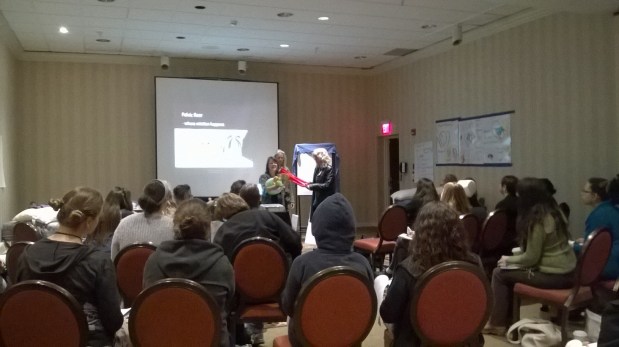
Spinning babies2

Demonstrating how the different muscle layers work to support or constrict the uterus

Another interesting aspect Gail brought out is how thyroid malfunction can cause the baby to assume a negative position. A root metabolism issue can affect the way in which the uterus operates, as well as causing it to be more susceptible to twisting. Making sure your entire body is working optimally can help prepare you for a better pregnancy and birth! The fact that we spend so much time sitting both in the car and in a reclined position also contribute to a asymmetrical uterus. Women used to be encouraged to sit “like a lady” with good upright posture, which can also help to promote good posture of the womb.

In presenting exercise techniques, Gail focused on three separate types of exercises that she calls the “3 Sisters” to provide balance and room for mom and baby. Each of these exercises helps the mom to relax, and thus in turn helps to relax the fascia of the uterus, which then helps to provide the balance to help the uterus to become more symmetrical. She would encourage pregnant mamas to do these exercises at the minimum of once a week, but once a day would be even more ideal! Besides encouraging baby to engage in a good position, these exercises can also help to improve mom’s comfort by relaxing the muscles that receive so much strain during pregnancy. In labor, these techniques help to promote descent of the baby, and can be done multiple times. Rather than try to explain these techniques myself, I’ll point you in the direction of where you can find instructions on her website:
– First, encourage deep squats and calf stretch. Then move on to the “3 Sisters of Balance” http://spinningbabies.com/techniques/activities-for-fetal-positioning/423-the-3-sisters-of-balance- :
1.  Rebozo sifting: helps relax the broad ligament and get the mother loose and relaxed herself. http://spinningbabies.com/techniques/activities-for-fetal-positioning/rebozo-sifting
2. Forward Leaning Inversion: This is best for resolving a transverse lie, and helps to encourage healthy circulation. http://spinningbabies.com/techniques/the-inversion
3. Side Lying Release: Helps relieve pressure on ligaments.

Once these techniques have been performed to help achieve balance, your next goals are Gravity and Movement-especially to help during a pause in labor.

During labor, you can use these techniques to help whenever you reach a point where progress is being stalled. Gail encouraged us to rethink the usual question of “what is dilation?” and instead think “where’s the baby?”. If the baby isn’t descending, then something needs to change, regardless of what dilation is. And depending on where baby is at, different techniques are needed to get the baby to descend. For any stall, she recommends trying the “3 Sisters of Balance” in order to relax mom and balance the uterus.

As you attempt the three above techniques, consider where baby is: If he is stuck at the brim of the pelvis (characterized by a long latent phase, or start-and-stop labors for days), then the baby needs to flex his head in order to enter the pelvis. Tight round ligaments can prevent baby from descending. At this point it is much more important to get the baby to enter the pelvis, rather than trying to get labor to become more regular. Dilation won’t do any good if the baby isn’t in the pelvis! Trying Gail’s Abdominal Lift and Tuck followed by Walchers, can help to flex that little guys head and get him to descend. http://spinningbabies.com/techniques/activities-for-fetal-positioning/abdominal-lift-and-tuck  http://spinningbabies.com/techniques/activities-for-fetal-positioning/walchers

If baby is stuck in the mid-pelvis (right at the ischial spines), labor tends to stall around 5-7cm. This can often be caused by a tight pelvic floor, and special attention to the side-lying release technique can help to relax those tight muscles. Trying a lunge, and the “Shaking the Apple Tree” techniques can also help to get the pelvic floor relaxed and help baby to descend.

When labor stalls around 9-10 cm (think anterior lip, etc), realize that you must address the root cause, not just push back the lip. Trying positions that open up that part of the pelvis can provide more room (deep squat, McRoberts, hip press, toilet, etc.). Sometimes putting pressure on the sacrotuberal ligaments can help them release and provide more room for birth. If there’s not an urge to push, try to rest, and wait until the body is ready-sometimes mama just needs a break!

There were many, many more things that Gail taught and shared…not to mention all the stories of different complicated, stalled labors where these techniques were used. If you ever have a chance to sit in on one of Gail’s classes, I would highly recommend it! Much of her information is located on her website, as well, which is an excellent resource for both midwives and mamas alike.

Spinning babies1

Where is baby’s position in relation to the mom’s pelvis? How can we use that information to help us decide which technique(s) to try?